From natural-language question to citable publication with grounded sources
Deep technical and scientific research takes hours of tab-skimming and reference checking. Naive LLMs hallucinate without grounded sources. UC1 automates the full loop: search, extraction, embedding, multi-agent synthesis, and Quarto rendering with verified BibTeX citations.
Vision: Autonomous research without compromising evidentiary rigor
A future where researchers, policy advisors, and technical leaders can generate deep, multidisciplinary syntheses in minutes that are just as verifiable, reproducible, and citable as peer-reviewed literature. Data stays on sovereign infrastructure; every claim retains an immutable audit trail.
Mission: Closing the full research loop on open-source infrastructure
Build an end-to-end multi-agent pipeline (CrewAI, SearXNG, Docling, Qdrant, Neo4j, Quarto) that ingests open web sources, extracts structured text and tables, and produces citable academic documents (.qmd, .docx, .pdf) with formal bibliographies and full experiment traceability in MLflow and Langfuse.
- Fully self-hosted: zero data leakage to third-party commercial clouds
- Separated agent roles: researcher, quality analyst, and writer cross-verify each step
- Temporal knowledge graph: run 50 builds on what run 1 discovered with zero re-discovery cost
- Single-source publishing: one Quarto document compiles to DOCX, PDF, RevealJS slides, and web
Why standard AI tools fail at rigorous research
Conversational LLMs generate fluent text, but science, governance, and policy require verifiable proof.
Hallucinations and fabricated citations: commercial LLMs routinely invent plausible-sounding papers and authors.
Naive RAG lacks document architecture: chunk retrieval produces fragmented snippets rather than a cohesive report.
Missing chain of custody: web chat interfaces provide no cryptographic hashes or audit trails for cited pages.
Heavy time sink: manually screening dozens of PDFs and writing up formal references consumes days.
Research Pipeline Epics & Roadmap
The pipeline is organized into five modular epics, with the core workflow validated end-to-end.
Question → Sourced Answer
SearXNG web/arXiv retrieval, Docling PDF parsing, and Qdrant vector storage produce a verified initial answer.
Grounded Synthesis Report
Three-agent CrewAI team (Researcher, Analyst, Writer) synthesizes complex topics with internal cross-checks.
Citable Publication
Quarto engine compiles DOCX and PDF with native [@citation] BibTeX keys and academic title pages.
Audited & Reproducible Service
Full token, latency, and cost tracing via Langfuse, with experiment parameters logged in MLflow.
Deep Research Knowledge Graph
Graphiti / Neo4j temporal graph persistence for cumulative discovery across consecutive runs.
Verified Pipeline Benchmark Results
Empirical data captured directly from the latest pipeline run (run_20260930_185045) on local cluster.
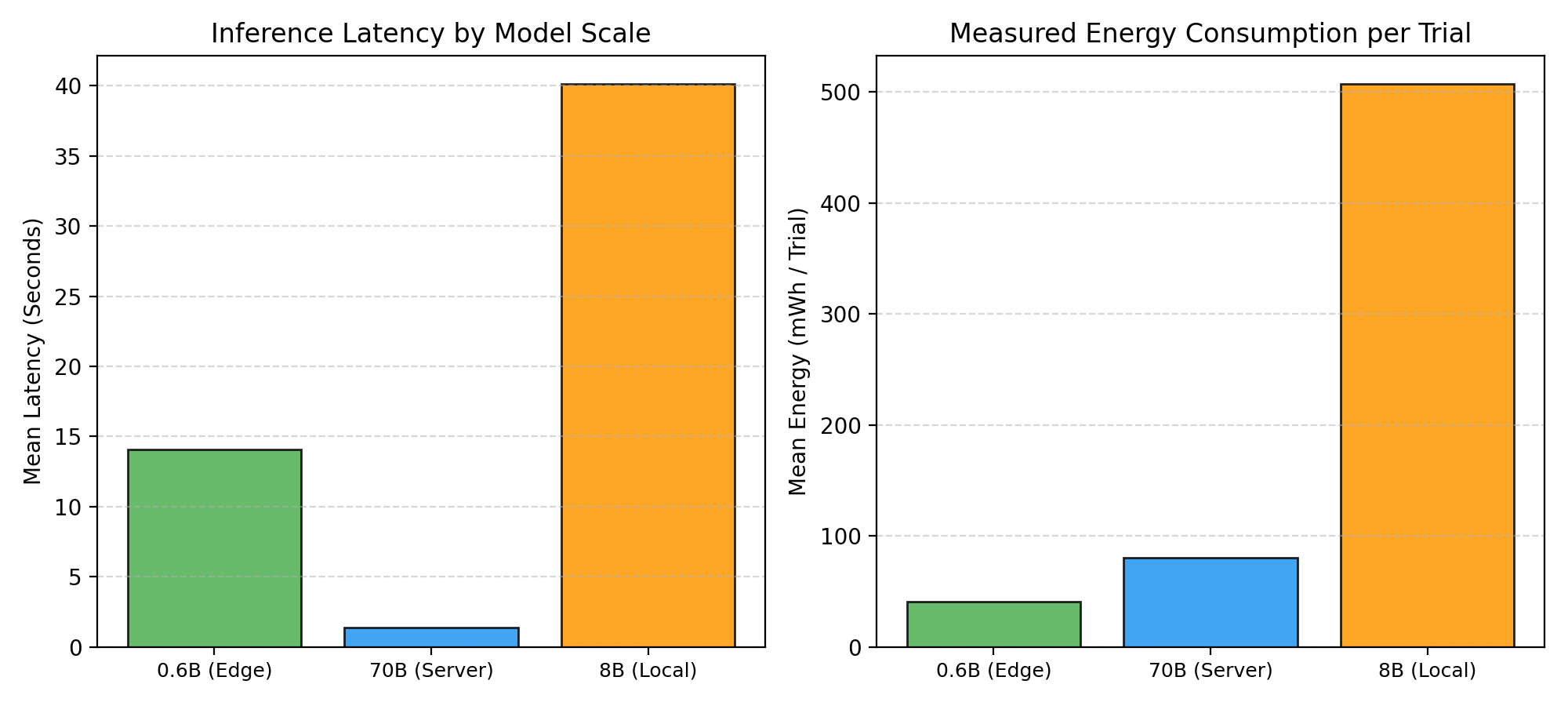
Empirical Energy & Scaling Profile
Energy consumption and latency per synthesis stage in the multi-agent execution loop.
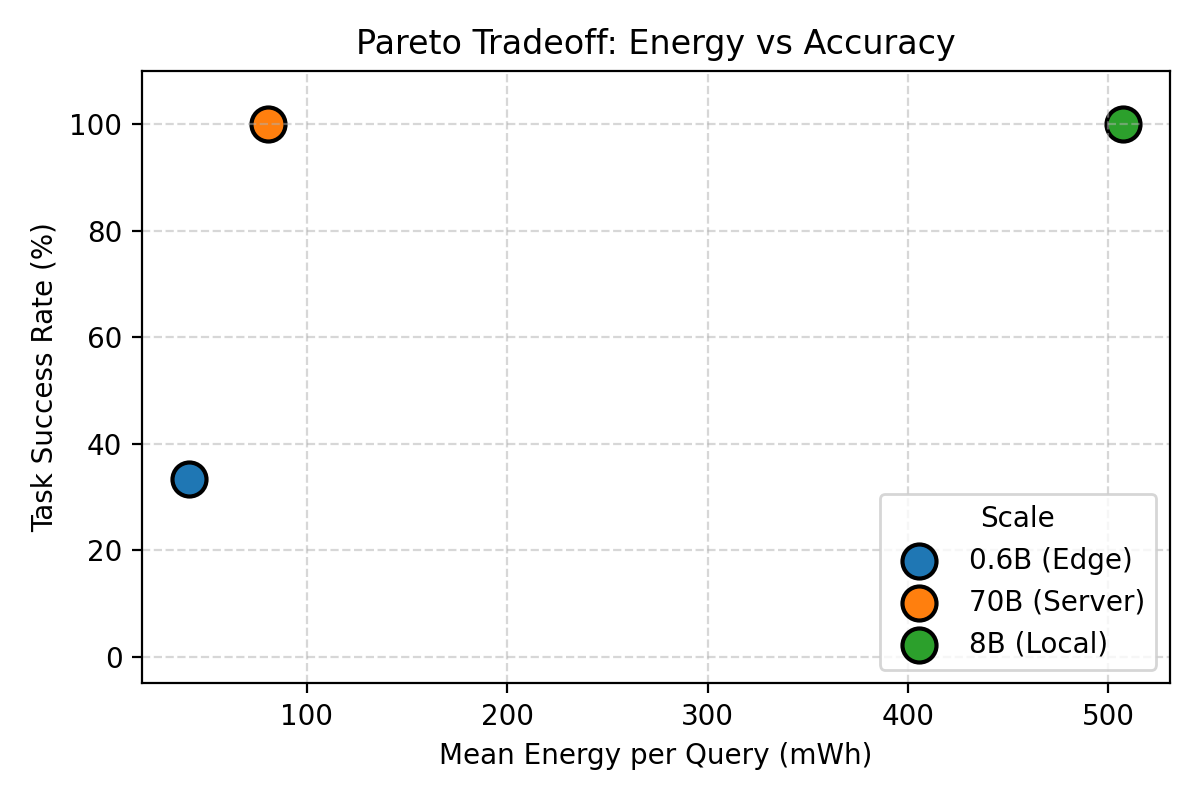
Pareto Frontier: Accuracy vs Latency
Optimal balance between source corpus depth, factual accuracy, and compute time.
Ready for reproducible research?
Introduce your team to the autonomous research pipeline or schedule a pilot run on your custom research questions.