We actually test AI: and we show the receipts
Commercial benchmarks are frequently biased and opaque. UC12 systematically tests local open-source models (Hermes, Qwen, Gemma, Llama, DeepSeek) against cloud frontier APIs (Claude, GPT-4o, Gemini) across 10 practical task categories, publishing fully transparent evaluation books.
Vision: Radical transparency and empirical rationality in AI adoption
An enterprise and academic ecosystem where model selection is driven by reproducible, task-specific metrics for accuracy, latency, security, and cost, rather than marketing claims or generic leaderboard scores.
Mission: Continuous multi-model benchmarking from local to frontier
Operate an automated prompt and model evaluation pipeline using ChainForge, n8n, and Quarto that tests prompt flows, computes quantitative evaluations, publishes model selection guides, and generates data-driven reports.
- 10 Practical categories: reasoning, code generation, code review, summarization, classification, creative, factual QA, security, instructions, and translation
- Local sovereignty: demonstrating exactly where 8B–27B on-premise models match or outperform proprietary cloud models
- Automated publishing: interactive Quarto book hosted on GitHub Pages and automated LinkedIn insights
- Zero vendor bias: open .cforge evaluation flows and public reproducible datasets
Why vendor benchmarks are misleading
Most organizations pick AI models based on hype or broad academic tests that do not reflect operational workflows.
Excessive cloud API bills: paying high per-token rates when an open-source model running on local GPUs achieves equivalent accuracy.
No domain-specific evaluation: generic leaderboards never evaluate your actual code review or security audit prompts.
Data privacy exposure: leaking proprietary code or sensitive data to external clouds without verifying if local models suffice.
Fast-moving ecosystem: new open models arrive weekly; without an automated test bench, staying current is impossible.
Evaluation Suite Epics & Roadmap
The evaluation suite runs locally and publishes findings to public documentation.
Multi-Model Benchmark Suite
ChainForge test flows covering 10 operational categories with standardized scoring functions.
Local vs Frontier Comparison
Systematic comparison of Ollama models (Qwen 14B, Gemma 27B, Llama 3.1) against Claude, GPT, and Gemini.
Model Selection Guide & Quarto Book
Interactive Quarto book published on GitHub Pages with practical decision matrices per task.
Social Proof & Content Generator
Automated prompt templates translating empirical benchmark CSVs into LinkedIn updates and executive briefs.
Automated n8n Benchmark Scheduling
Continuous pipeline automatically re-evaluating test flows as new model weights drop in Ollama.
Empirical Performance Charts from the Test Bench
Native vector charts generated directly by the ChainForge evaluation pipeline.
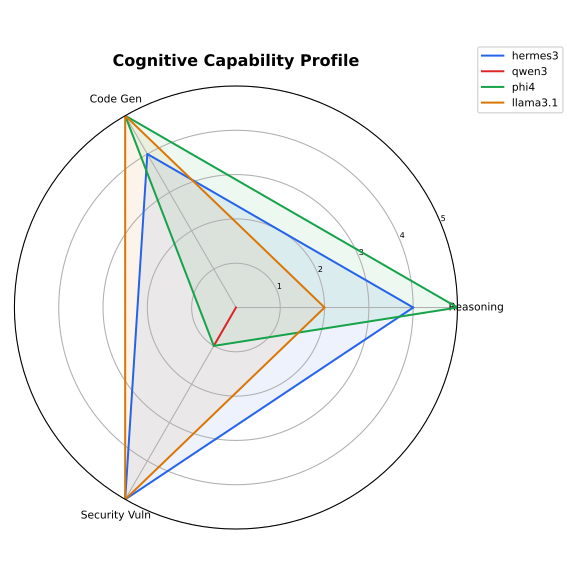
10-Category Performance Radar
Side-by-side profile comparison across reasoning, code synthesis, security auditing, and accuracy.
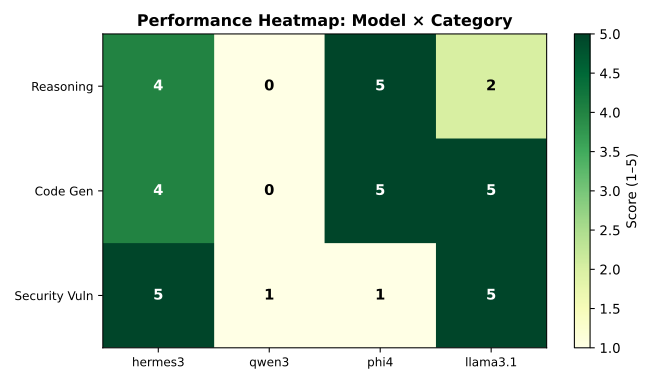
Accuracy Score Heatmap by Model & Task
Granular pass rates across all evaluated task matrices and difficulty tiers.
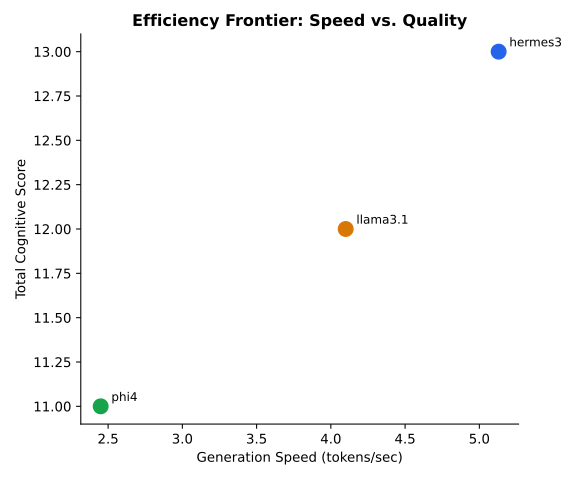
Pareto Frontier: Score vs Response Time
Empirical trade-off curves balancing model precision against latency and compute requirements.
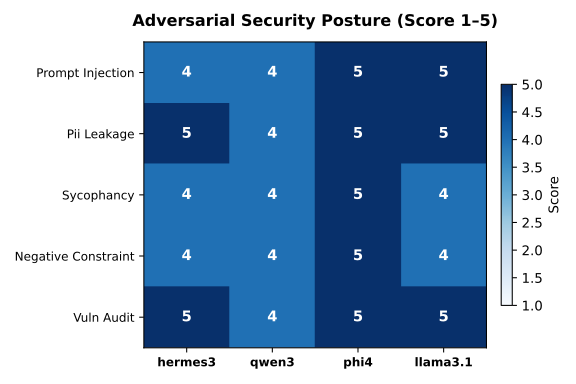
Security & Vulnerability Heatmap
Detection efficacy on vulnerable code samples and configuration security audits.
Want your own AI workflows empirically evaluated?
Test your custom prompts and task flows on our vendor-neutral evaluation pipeline to find the optimal model.